About
This is a week-long workshop on quantitative type theory and its applications, with two days of talks followed by three days of working groups. The participants focus on:
- proof theory and semantics of quantitative logics, and their use as a foundation for differentiable logics, where the interpretation of a formula is the loss used to train a neural network;
- propositional and higher-order logics over the Lawvere quantale, for metric reasoning about probabilistic programs and processes;
- categorical semantics of quantitative predicates and quantifiers: hyperdoctrines, fibrations, and monads of probability measures on metric spaces;
- formalisation in proof assistants, from fuzzy and differentiable logics in Rocq and MathComp to probabilistic programming in guarded type theory.
Programme
Monday afternoon and Tuesday are for talks, nine in total, each 30 minutes plus 10 minutes of discussion. From Wednesday we split into working groups. Everything takes place in the Classroom at the Pioneer Centre.
Monday 23 — quantitative logics: proof theory and semantics
- 12:15Lunch
- 13:15Welcome and plan for the week
- 13:30Rasmus Ejlers Møgelberg — Induction and Recursion Principles in a Higher-Order Quantitative Logic for Probability
- 14:10Giorgio Bacci — An Analytic Hypersequent Calculus for Affine Lawvere Logic
- 14:50Coffee
- 15:20Ekaterina Komendantskaya — Adequate Losses via Quantitative Linear Logic
- 16:00Matteo Capucci — First-Order Quantitative Linear Logic
- 16:40–17:15Open discussion: topics for the working groups
Tuesday 24 — formalisation, calculi, and applications
- 09:00Coffee
- 09:30Janis Bailitis — Quantitative Substructural Logics and Soft Residuated Lattices in Rocq
- 10:10Alessandro Bruni — Rocq Infrastructure for Quantitative Logics in MathComp-Analysis
- 10:50Coffee
- 11:20Alessio Coltellacci — λ-FQLL: a Sensitivity Calculus and a Soft First-Order Quantitative Logic
- 12:00Lunch
- 13:00Alessio Coltellacci — Higher-Order Quantitative Linear Logic over Quasi-Borel Spaces
- 14:20Coffee and a visit to the telescope in the observatory tower
- 14:50–16:30Working-group formation: pick topics, split up, plan Wednesday to Friday
- EveningWorkshop dinner
Wednesday 25 – Friday 27
- All dayWorking groups in the Classroom; short plenary wrap-up on Friday afternoon
Talks
-
Induction and Recursion Principles in a Higher-Order Quantitative Logic for Probability Rasmus Ejlers Møgelberg · IT University of Copenhagen
Quantitative logic reasons about the degree to which formulas are satisfied. This talk studies the fundamental reasoning principles of higher-order quantitative logic and their application to reasoning about probabilistic programs and processes. We construct an affine calculus for 1-bounded complete metric spaces and the monad for probability measures equipped with the Kantorovich distance. The calculus includes a form of guarded recursion interpreted via Banach's fixed point theorem, useful, e.g., for recursive programming with processes. We then define an affine higher-order quantitative logic for reasoning about terms of our calculus. The logic includes novel principles for guarded recursion and induction over probability measures and natural numbers.
We illustrate the expressivity of the logic by a sequence of case studies: proving upper limits on bisimilarity distances of Markov processes, showing convergence of a temporal learning algorithm and of a random walk using a coupling argument.
-
An Analytic Hypersequent Calculus for Affine Lawvere Logic Giorgio Bacci · Aalborg University
Affine Lawvere Logic (AL) is a propositional logic whose formulas take values in the Lawvere quantale [0, ∞]. Its connectives are tensor (interpreted as addition), linear implication (truncated subtraction), the constant 1, and scaling by non-negative reals; together, these can express general affine combinations. Bacci et al. (MFPS 2023) gave a sequent calculus for AL and proved it (finitely) complete with respect to the quantale-valued semantics. However, that calculus lacks a property proof theorists usually ask for: cut-free analytic proofs.
In this talk, I present an alternative calculus based on hypersequents that addresses this gap. The calculus has no cut rule — so it is cut-free by construction — and every inference rule has the subformula property: each formula in a premise is a subformula of a formula in the conclusion. I show that the calculus is sound and complete with respect to the quantale-valued semantics, and therefore equivalent to the original system of MFPS 2023.
-
Adequate Losses via Quantitative Linear Logic Ekaterina Komendantskaya · University of Southampton
As neural components are increasingly embedded in existing symbolic software — including safety-critical systems — the question arises of how to specify and enforce the safety of the newly introduced neural parts. Unlike traditional logical specifications, these must be amenable not only to the standard Boolean interpretation, but also to training and optimisation. The latter calls for a quantitative interpretation of the logical syntax, subject to further requirements such as smoothness and differentiability. Moreover, the qualitative and quantitative sides of the logic must share a unifying proof-theoretic and categorical semantics. Finally, the new logic should link cleanly to the substructural and program logics that underpin the verification of existing symbolic programs.
In this talk, I present a logic that ticks all of these boxes. We introduce a family of calculi, pQLL, indexed by a hardness degree p, prove a cut-elimination theorem for them, and establish completeness with respect to enriched residuated ‘soft’ lattices. At p = ∞, pQLL reduces to multiplicative additive linear logic (MALL), and provability in pQLL converges to provability in MALL as p → ∞. We express optimisation objectives in the syntax of this logic and prove the quantitative adequacy of neuro-symbolic loss functions — a result that has eluded the neuro-symbolic machine learning community for nearly a decade.
Joint work with Matteo Capucci, Robert Atkey, Charles Grellois and Matthew Daggitt. arXiv:2605.13348
-
First-Order Quantitative Linear Logic Matteo Capucci · Independent researcher
I will outline the current status of the programme for the construction of a first-order extension to QLL, with intended semantics in finite measure spaces. The goal is to come up with a logic and a categorical model theory that can be used to account structurally for ideas and patterns occurring in quantitative disciplines, chiefly machine learning.
The work started in [1] where I outlined how p-integrals behave very much like quantifiers, for predicates being real-valued random variables on probability spaces. However, I couldn't come up with a proof calculus nor a traditional categorical model for them. In [2], we took care of the connectives of the logic, dealing with the propositional case and coming up with quantitative proof calculi, which can be considered the proof-theoretic counterpart to categorical models proposed by Lawvere [3].
The talk picks up where [1] left, with the crucial observation that to make a hyperdoctrine out of this logic we need to work gradedly and enrichedly. By grading entailment with softness annotations, we are able to recover reflexivity (AX rule) and transitivity (CUT), which turn out to correspond to a suitable dual of Hölder's inequality. We then sketch a quantitative sequent calculus for this model, extending the ideas of [2] and using lessons from traditional ‘quantitative’ type theory, chiefly [4], to handle the softness annotations.
In the talk I'll highlight the delicate back-and-forth between calculus and model that these last 3 years have been, trying to motivate the choices we made along the way.
The talk is based on work with Matteo Spadetto, and conversations with many other participants at the workshop.
-
Quantitative Substructural Logics and Soft Residuated Lattices in Rocq Janis Bailitis · Heriot-Watt University
Substructural logics come with a rich algebraic theory organised around residuated lattices, and have a substantial history of mechanisation in proof assistants. Recently, the machine learning community introduced differentiable logics: fuzzy-style logics whose connectives must be differentiable and monotone. These analytic requirements clash with the algebraic tradition underlying substructural logics as no connective can be simultaneously idempotent, associative, and shadow-lifting. This seems to suggest that differentiable logics can never join the family of substructural logics, but the quantitative linear logic (QLL) of Capucci et al. resolves this tension by smoothing the lattice connectives into parametrised p-sums, which trade idempotence for its graded, soft variant.
In this talk, we firstly discuss a Rocq mechanisation of QLL: we mechanise QLL's quantitative sequent calculus, establishing cut elimination and consistency, and we prove that QLL's p-sums are differentiably monotone using the MathComp-Analysis library. Secondly, we give a short glimpse into the study of quantitative substructural logics, organised around soft residuated lattices. Concretely, we define a hierarchy of algebraic structures spanning residuated lattices, the algebras of fuzzy logics, and the algebras of linear logic, extended with their soft variants.
Joint work with Reynald Affeldt, Alessandro Bruni, Alessio Coltellacci, Ekaterina Komendantskaya, and Kathrin Stark.
-
Rocq Infrastructure for Quantitative Logics in MathComp-Analysis Alessandro Bruni · IT University of Copenhagen
This talk surveys the Rocq infrastructure we are building for quantitative logics on top of MathComp-Analysis. On the probability side, our work on concentration inequalities (ITP 2025) grew into a general library: types for numeric values, a lightweight semi-decision procedure based on interval arithmetic, and an extension of the hierarchy of mathematical structures to Lebesgue spaces. On the algebraic side, I will present the hierarchy of structures we built for quantitative linear logic: residuated lattices, the algebras of fuzzy and linear logics, and their soft counterparts, in which idempotence is traded for parametrised p-sums proved differentiably monotone.
On the semantic side, with Alessio Coltellacci we are formalising complete extended metric spaces, Banach's fixed point theorem, Wasserstein distances and disintegration, driving the proofs with LLM-based agents through a Rocq MCP server. The mathcomp-qbs project has formalised quasi-Borel spaces and their probability monad the same way. I will discuss what this way of working changes about library design, review and trust.
-
λ-FQLL: a Sensitivity Calculus and a Soft First-Order Quantitative Logic Alessio Coltellacci · IT University of Copenhagen
Quantitative logic takes its truth values in the Lawvere quantale [0, ∞] and can be interpreted in extended metric spaces, where the equality of two points is the exponential of their distance. Transitivity of equality then becomes the tensor of linear logic, and the sensitivity of terms must be tracked by the logic itself: from x = y one cannot conclude 2x = 2y, but from 2(x = y) one can.
This talk presents λ-FQLL, a sensitivity-typed λ-calculus interpreted in the category of complete extended metric spaces, with scaling of types, guarded recursion via Banach's fixed point theorem, and probabilistic choice via the Wasserstein monad, together with its internal first-order quantitative linear logic. The quantifiers of the logic are soft: quantifying over a distribution computes a generalised mean, with supremum, infimum and expectation as special cases. The logic has Leibniz equality, guarded recursion for propositions and induction over the natural numbers. As an example, we bound the bisimilarity distance between two Markov processes by reasoning with couplings. The development is being formalised in Rocq.
-
Higher-Order Quantitative Linear Logic over Quasi-Borel Spaces Alessio Coltellacci · IT University of Copenhagen
Higher-order probabilistic reasoning needs a category in which probability distributions, higher-order functions and continuous sample spaces coexist; measurable spaces are not cartesian closed, but quasi-Borel spaces are. This talk presents a categorical semantics for a higher-order quantitative linear logic over quasi-Borel spaces.
We introduce locally graded, enriched preorders: preorders whose inequalities carry a grade and are witnessed by a value in [0, ∞], so that graded transitivity is Hölder's inequality. Over the category of quasi-Borel spaces equipped with a probability measure, with measure-non-increasing maps, we build a doctrine of quantitative predicates whose entailment is graded by a softness parameter and computed as a generalised mean. Quantifiers arise as graded adjoints to reindexing along projections, and are again means. From the doctrine we extract a sequent calculus with soft quantifiers and Leibniz equality.
Participants
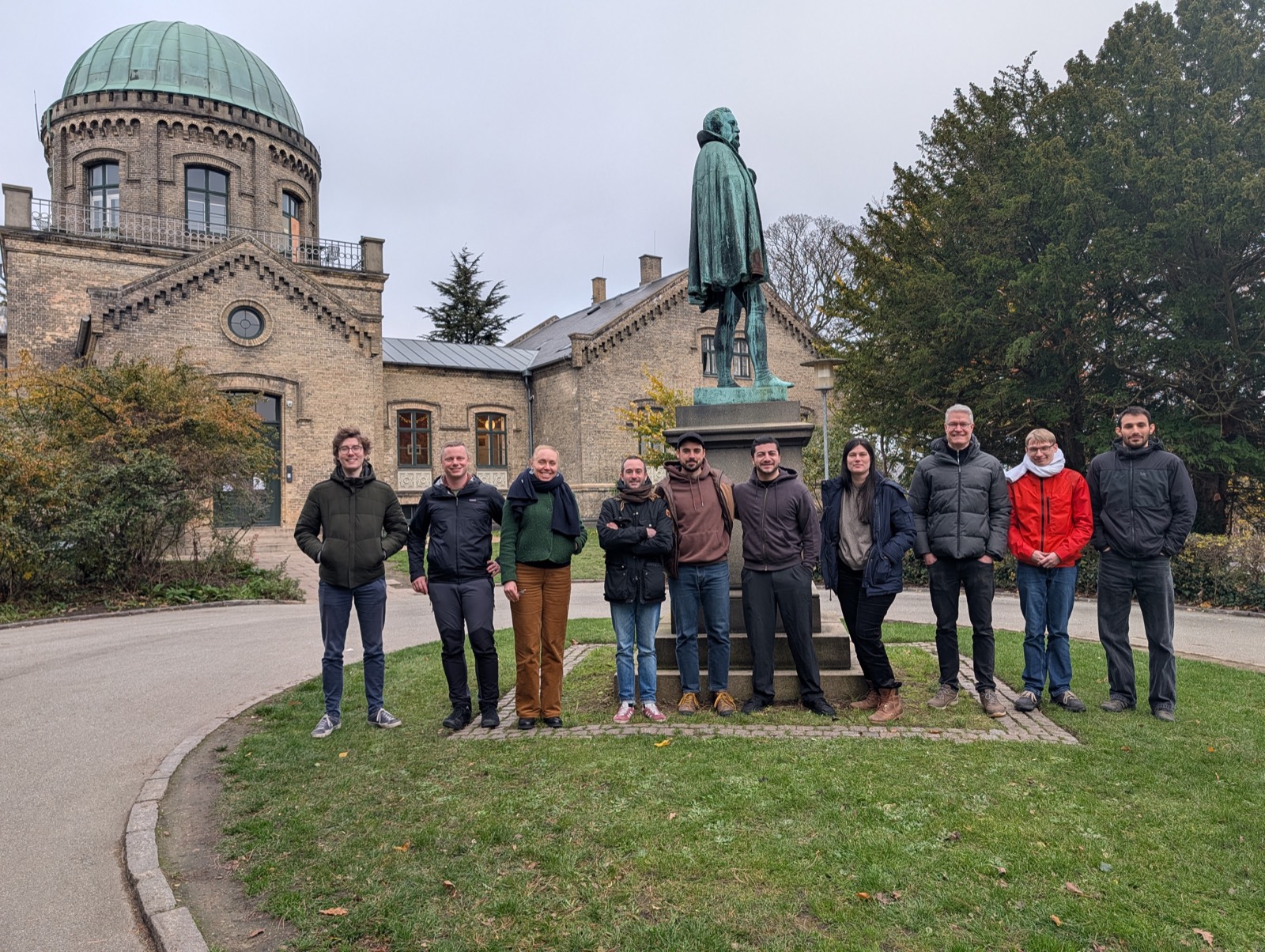
- Giorgio BacciAalborg University
- Janis BailitisHeriot-Watt University
- Alessandro BruniIT University of Copenhagen
- Matteo CapucciIndependent researcher
- Alessio ColtellacciIT University of Copenhagen
- Sam GhalayiniTechnical University of Denmark and IT University of Copenhagen
- Ekaterina KomendantskayaUniversity of Southampton
- Maria Bendix MikkelsenIT University of Copenhagen
- Rasmus Ejlers MøgelbergIT University of Copenhagen
- Matteo SpadettoUniversity of Nottingham
- Kathrin StarkHeriot-Watt University
- Maaike ZwartIT University of Copenhagen
Venue
The whole week takes place at the Pioneer Centre for Artificial Intelligence, Øster Voldgade 3, 1350 Copenhagen K, next to the Botanical Garden. Talks on Monday and Tuesday, and the working groups from Wednesday to Friday, are in the Classroom.
Nearest stations: Nørreport (metro, S-train, regional trains), five minutes on foot. The building is card-access: on Monday we meet you at the entrance from 12:00, and guest cards for the week are arranged by the organisers.
Attendance
There is no registration: the organisers arrange participation directly with each participant. There is no fee, and the venue and the workshop dinner are covered by the organisers.
Organisers
- Alessandro BruniIT University of Copenhagen
- Alessio ColtellacciIT University of Copenhagen
Questions? Write to Alessandro Bruni or Alessio Coltellacci.